
What This School Year Taught Me (And the Classroom Strategies I'm Changing Next Year)

Summer is finally here. Graduation is over, and I said goodbye to some pretty great seniors. I'm definitely not looking forward to next year — my first group of freshmen from my current school graduates then, and I'm already feeling it.
The end of the year always brings about a time of reflection. Reflection on what the future holds and on what the past year brought. Before I completely check out for the summer and start planning, I wanted to look back and celebrate both the successes and the struggles of the past year, while also looking ahead to classroom strategies for next year.
The Successes
My ELL Students Exceeded My Expectations

This year, I had two geometry classes made up entirely of English Language Learners, and honestly, they blew me away.
The district required a standardized geometry midterm that had some real issues — several questions had multiple correct answers, and the content wasn't evenly distributed over what students were actually expected to have learned. Despite that, one of my classes averaged 43% and the other 51%, compared to a district average of 48%.
I know those numbers might not seem great, but context matters. Several of my students could barely read in English at the start of the year, and they still worked through every single question and tried their best. So many of them started off far below grade level and showed incredible growth in both their math skills and their language skills. I am so proud of them.
I Actually Stayed Organized This Year
I did a much better job of keeping track of papers this year. I cleared my desk at least once a week, kept tests and quizzes filed away, and my board organization system actually worked. Students eventually learned to use it to see what we were doing each day. I didn't update the design as often as I wanted to reflect the changing seasons, but everything stayed posted — and that counts.
The Struggles (And My Classroom Strategies for Next Year)
Students Using AI on Homework

This was a constant struggle. My students were using AI to complete their homework, which meant they always had the work done but never knew what any of it meant. They had correct answers with no understanding behind them. This was especially challenging in my year-long geometry class — we had less time to get work done in class because we were always backtracking for remediation. I kept asking them to show their work, stressing the importance of actually practicing the skills. For some students, it eventually clicked. For others, it never did.
At a certain point with one class, I honestly gave up checking. They always had the work done. It just meant nothing.
What I'm changing: I'm making changes to my assignments next year to combat this. My goal is to focus more on the process and less on the answers. This means including thinking questions and changing up the way students have to respond. I share more of my thoughts on AI and homework in this post.
My Word Wall Became a Crutch
I included too much on my word wall this year — too many formulas and definitions. My students never actually learned the material because it was always right there on the wall. They never memorized that vertical angles are congruent because why would they?
Next year, I'm teaching Geometry and Algebra 1, which is the EOC course. Those students will take a state-wide exam with no references. They cannot rely on the word wall — they need to actually know and remember the information. So many students struggled to retain anything from day to day, let alone from when they learned it to test time. They really struggled on my final exam this year.
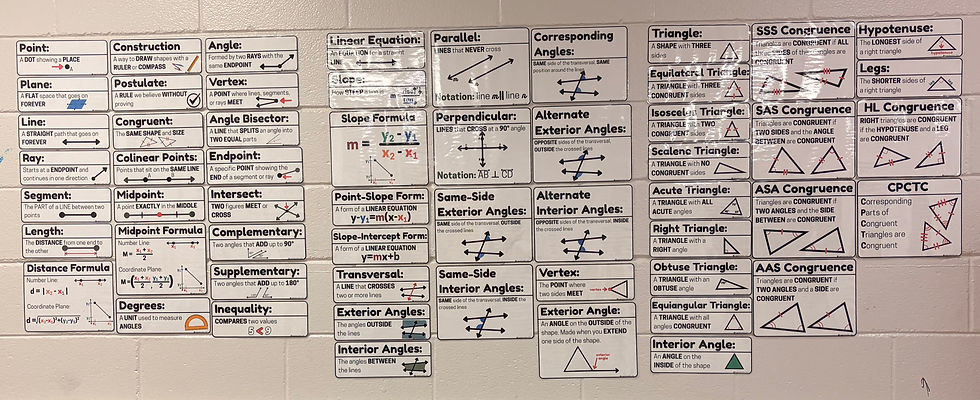
What I'm changing: I'm slimming down my word wall and focusing it on background vocabulary rather than essential concepts or formulas. I'm also putting the whole thing up at the beginning of the year to allow for varied pacing and to take some of the upkeep stress off my plate — keeping up with adding terms was genuinely hard to manage. A future post will lay out my full word wall plan.
Getting Students to Think Critically About Their Own Mistakes

This one was tough. We would go over tests and quizzes, I could even point out mistakes directly, and students would still struggle to identify what they did wrong. That made it really hard for them to improve — they kept making the same errors over and over.
Later in the year, I started having students walk through a reflection process to make corrections on their tests. It helped some of them by forcing them to slow down and actually think through what went wrong. It also taught them to go back through their notes and use them as a reference. Others still rushed through it.
What I'm changing: I'm planning to use this process more consistently next year from the start, rather than introducing it halfway through. I'm hopeful I'll see better results.
Looking Ahead
Next year is still full of unknowns. I don't know who my students will be or how they'll respond in my classroom. What works one year might not work the next. What I do know is that I'll keep reflecting and keep making changes to better support whoever walks through my door.
I can't wait to share everything I'm changing in the coming weeks. And I'm genuinely hopeful — I can't wait to watch this new group of students grow.
Are you doing an end-of-year reflection? I'd love to hear what's on your list — drop it in the comments below.


Comments